
10 Panel
- SAFElife™ T-Dip 10-Panel Urine Test Card (with Amphetamine & Buprenorphine)$202.50What a 10-panel dip card detects10-panel urine dip card for…
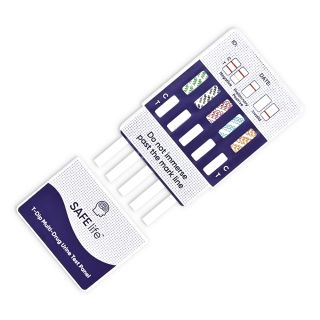
Ten-panel screens are the most widely specified configuration in workplace and clinical programs. Thirteen configurations in stock across integrated cup, compact cup and dip card.
All formats use the same lateral-flow chemistry — the difference is collection and cost.
Buying guideThe thirteen configurations, and how they differ
What a 10-panel test covers
Ten panels extend the standard five with barbiturates, benzodiazepines, methadone, MDMA and either oxycodone or buprenorphine. Thirteen configurations means the analyte sets differ — two products both called 10-panel may not test for the same ten. Each product’s chart lists its own set with cutoffs.
Which ten you need
The variable positions are usually MDMA versus oxycodone, and buprenorphine versus propoxyphene. If your protocol names the substances rather than the count, match the chart. If it names only the count, the most commonly specified set is AMP, BAR, BZO, COC, mAMP, MDMA, MTD, OPI, PCP and THC.
Adulteration checks
Several configurations add creatinine, specific gravity and pH — the three-adulterant option. These detect a diluted or substituted sample rather than a substance, and they matter where collection is unobserved.
Regulatory status
All ten-panel configurations on this page are CLIA-waived and usable for clinical decisions in a CLIA-waived setting.
Ordering
Cups are sold by the case, 50 or 100 tests. Dip cards are sold by the case, 50 or 100 cards.