Med Supply Lab
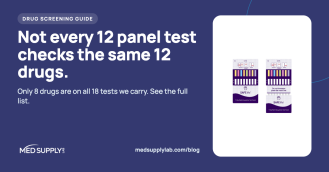
- - October 12, 2026Not every 12 panel drug test checks the same 12 drugs. The full list, what each code means, and how to pick the right test for your program.
- - September 30, 2026
Supply costs are going up. In the American Hospital Association's 2026 Environmental Scan, 82% of healthcare executives said they expect supply costs to rise by as much as 15%.
Most of the attention goes to the big contracts. The small pharmacy supplies get passed over: medicine bottles, child-resistant closures and medicine cups. They get reordered every month, so small savings repeat. Here are five ways to keep those reorders in check.
1. Compare the price per unit, not the price per case
Everything we sell goes by the full case. We show the per-unit price right under the case price, because that is the number you can compare against any other supplier.
2. Buy matched cases
A case of 30cc medicine bottles is 2,000. A case of 28-400 closures is also 2,000. One case of each pairs exactly, with nothing left over on the shelf. The 30cc bottle holds tablets, capsules, powders and liquid medication.
3. Stock one closure for two bottle sizes
The same 28-400 child-resistant closure fits both
- - August 28, 2026
Your freight bill is not about weight. Dimensional weight, the 2026 carrier rate increase, and three things that actually reduce a freight bill.
- - August 21, 2026
Two substances now common in the illicit opioid supply do not appear on a standard point-of-care panel. What the CDC advisory on medetomidine and the June carfentanil data mean for programs running required random drug testing.
- - August 15, 2026
Returned meds, sharps and red-bag waste share one loading dock but answer to three different regulators — the DEA, OSHA and DOT. Here's where facilities actually get caught: not the stream they hold a contract for, but the one still running on habit.
- - August 03, 2026
For most opioid treatment programs, 2026 is shaping up to be a year of doing the same work with a budget that isn't growing. In its FY2026 request, the federal government proposed folding the three main behavioral-health block grants — community mental health, substance use prevention and treatment, and state opioid response — into a single Behavioral Health Innovation Block Grant that comes in roughly $500 million below the combined total of the programs it replaces. Direct opioid-treatment-program funding is held flat, and proposed Medicaid reductions add pressure on the reimbursement side. Set the politics aside; the operational takeaway is simple. The money to run your program is, at best, holding steady while everything around it costs more.
At Med Supply Lab, we supply medicine bottles, child-resistant caps and dosing cups, so we spend our days on the supply side of exactly this problem. When budgets tighten, procurement gets a harder look, and it should. But where you look matters,
- - July 24, 2026
More medication is going home under the expanded take-home rules — which quietly turns the take-home container into a frontline item. Here's what "supply-room ready" means: certified child-resistant bottles, matching caps, and enough depth of stock to keep up.
- - July 17, 2026
For an OTP purchasing team, the costliest supply gaps are the ones you can’t plan for. Here’s what a stockout really costs — and how consolidating to one dependable source makes spend easier to predict and budget.
- - July 10, 2026
A supply gap in an OTP costs more than the missing item — it costs staff time, certainty, and focus. Here's the hidden cost of running out, the "multi-vendor tax," and what one dependable single source actually looks like.
- - July 06, 2026
Induction foil and pressure-sensitive cap seals do the same job in different ways. Here's how OTP clinics can choose the right liner for their take-home bottles.
- - June 27, 2026
Leftover, expired, and wasted methadone is a diversion risk and a compliance obligation. Here's how on-site activated-carbon drug deactivation renders unwanted medication non-retrievable — and how to choose the right format for your clinic.
- - June 20, 2026
When an OTP's automated dosing pump fails, dosing can't stop. Here's why a precise, reproducible manual bottle-top dispenser belongs on every program's shelf as a backup — and what makes a good one.
- - June 12, 2026
In an OTP, the dosing cup is one of the smallest tools in the room and one of the most important. Here's what makes a good dosing cup and why the details matter for accurate, hygienic dosing.
- - June 05, 2026
An Opioid Treatment Program (OTP) is a federally certified provider that dispenses medication for opioid use disorder. Here is a plain-language look at how OTPs work, who oversees them, and why take-home supplies matter.
- - September 25, 2024
"CR" stands for child-resistant. Here's what CR-certified packaging actually means (PPPA, 16 CFR 1700.15), why it matters for take-home medication, and what to look for in a supplier.