
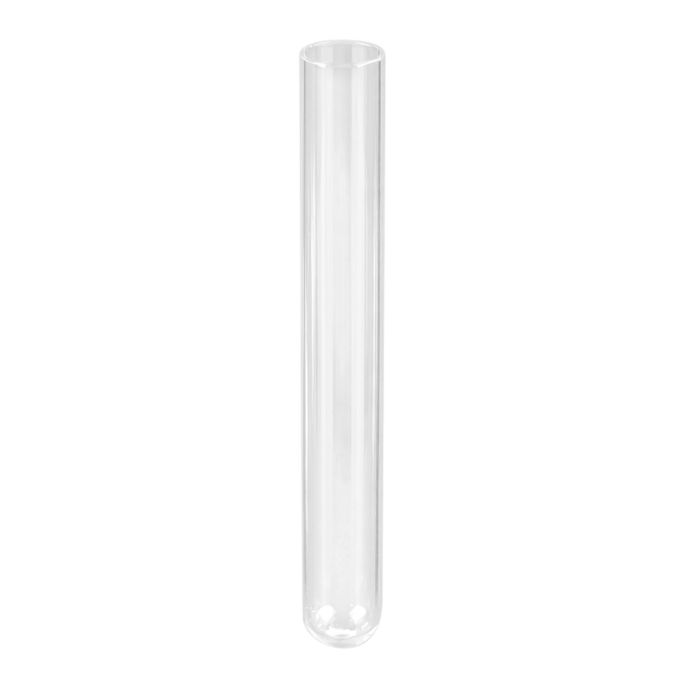
Globe Scientific Borosilicate Glass Culture Tube, 13×100mm, 10mL
Product Highlights
- Size / capacity: 13 × 100 mm, 10 mL
- Material: Borosilicate glass
- Sterility: Non-sterile
- Pack: Case of 1,000 (250/box × 4 boxes)
Globe Scientific Borosilicate Glass Culture Tube, 13×100mm, 10mL
A general-purpose 13 × 100 mm borosilicate glass tube from Globe Scientific, holding 10 mL, with a fire-polished rim and a well-rounded bottom.
Details
General-purpose borosilicate glass in the standard rack size
This is a 13 × 100 mm borosilicate glass culture tube holding 10 mL, made by Globe Scientific and sold by the case of 1,000 — 250 tubes to a box, four boxes to a case.
Why borosilicate
Borosilicate is the glass laboratories use when a tube has to go somewhere a plastic tube should not: heat, autoclaving, solvents and strong reagents. It expands very little when heated, which is what lets it survive the temperature changes of sterilising and flaming without failing. For culture work, general chemistry, sample holding and anything that gets warmed, glass is still the default and borosilicate is the grade that holds up.
How it is finished
The rims are smooth and fire-polished and the bottoms are well rounded. Both matter in daily handling: a fire-polished rim seats a cap or a plug cleanly and is far kinder to gloves and fingers than a cut edge, and a well-rounded bottom pours out and cleans out without a corner for residue to sit in. Globe manufactures these in an ISO 9001:2015-certified factory.
How it is packed
Tubes arrive 250 to a shrink-wrapped TubeSaver box, four boxes to the case, which is simply a practical answer to the problem of glass tubes arriving broken. It also means a bench can open one box at a time instead of a case of 1,000.
Who uses them
Clinical, research, teaching and industrial laboratories — culture work, sample holding, dilutions and general bench chemistry.
What it is used with
It shares the 13 × 100 mm format with our urine collection vacuum tube, so both sit in the same racks. See the full specimen collection range.
Sterile vs. non-sterile — why it matters here
This tube ships non-sterile, which is correct for general-purpose lab use but matters when a sample has to stay uncontaminated. In our specimen range, sterility is split by task, not by one blanket rule. The 90 mL specimen container and the 120 mL urine cup are sold sterile because they hold a sample straight from the patient and have to stay clean until the lab opens them. The transfer pipette and the biohazard transport bag are non-sterile, because they only move or carry a sample that is already secured. This tube sits in that second group: it is for culturing, diluting, reagents, or general bench work after a sample has already been collected, not for taking a sample directly from a patient. Mixing them up either wastes money on sterility nobody uses, or risks a contaminated result — if a workflow needs a sterile vessel for initial collection, start with the sterile container or cup, not this tube.
Where 13 × 100 mm fits in a lab
13 × 100 mm is one of the most common rack sizes in a laboratory, which is why this tube and the urine collection vacuum tube share it — both drop into the same centrifuge buckets, tube racks and transport trays without an adapter. A lab that standardizes on one rack size can mix empty glass tubes and sample tubes in the same tray without sorting them first. Four boxes to a case, 250 tubes per shrink-wrapped TubeSaver box, keeps that supply on the shelf in a size that matches how most benches already organize tube storage. Culture work, serial dilutions, reagent prep and general chemistry all use this same footprint, so one case covers several jobs rather than one.
Reordering glass tubes
Glass tubes are a consumable, so the useful question is how fast a bench goes through a box. At 250 to a box, a lab using one box a week works through a case of 1,000 in about a month. Opening one box at a time keeps the rest shrink-wrapped and protected until it is needed. These tubes ship without caps, so order closures or covers alongside them if the work calls for them.
Common questions
Does it ship sterile? No — this tube is non-sterile, suited to general lab use rather than direct sample collection.
Can I order less than a case? No — like everything in the specimen range, this is sold by the case only: 1,000 tubes, 250 to a box, four boxes to a case.
Does it come with a cap? No — these are open tubes; pair them with a closure or cover suited to the task.
Key features
- • Borosilicate glass
- • Fire-polished rim, rounded bottom
- • Chemical resistance
- • 250/box, 4 boxes/case
Used in
- • Culture & general laboratory use
- • Sample prep & storage
- • Blood bank & tissue culture
Compliance & Safety
Non-sterile general laboratory consumable. By Globe Scientific.